What Is an Electric Go-Kart and How Does It Work?
An Electric Go-Kart is more than a small vehicle with a battery. It is a compact electric machine designed to deliver controlled speed, immediate torque, and predictable handling. Unlike a petrol kart, it produces no exhaust fumes during operation. The experience feels quieter, cleaner, and surprisingly direct. Push the accelerator, and the motor responds almost instantly. That quick response can surprise beginners.
Alejandro Agag, founder of Formula E, has said, “The future of motorsport is electric.” His statement reflects a wider industry shift, although it does not explain every engineering detail. An Electric Go-Kart usually combines a lithium-ion battery pack, an electric motor, a motor controller, a throttle sensor, and a braking system. The battery stores direct-current electricity. The controller regulates that energy before sending it to the motor. The motor then turns the rear axle, often through a chain or direct-drive arrangement.
The process sounds straightforward. It is not perfectly simple. Battery weight affects cornering, while motor power influences acceleration and heat production. A controller also limits current to protect the battery and motor. Some models use regenerative braking, but many rental karts rely mainly on mechanical brakes. That difference matters. Drivers may feel less engine noise, yet they still need careful throttle control. Range depends on battery capacity, driver weight, track layout, temperature, and driving style. Understanding these parts makes the technology easier to evaluate. It also prevents exaggerated claims about speed, safety, and performance.
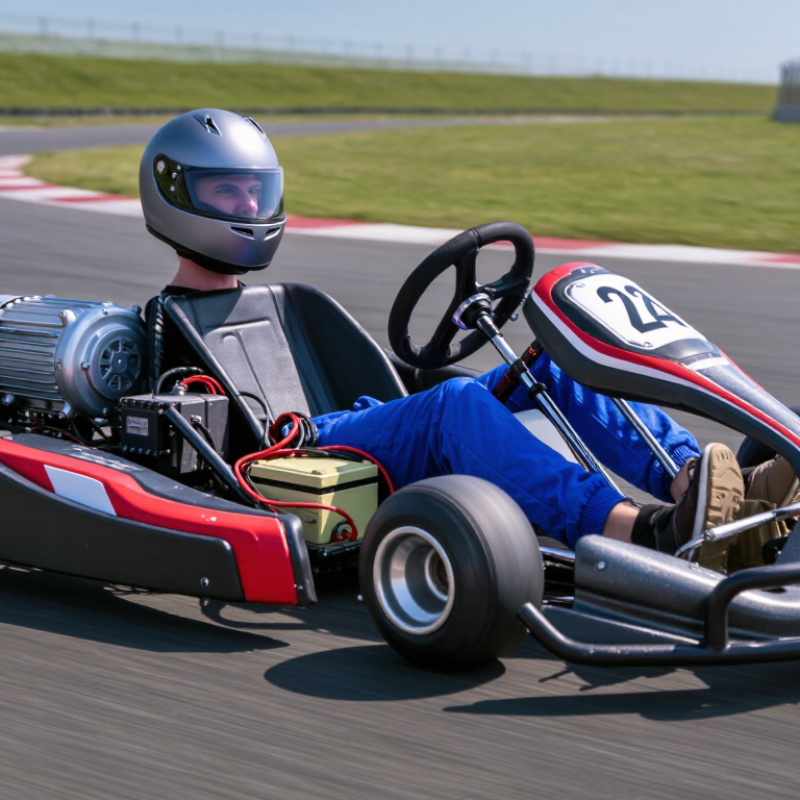
Definition and Core Purpose of an Electric Go-Kart
An electric go-kart is a small, low-slung vehicle powered by an electric motor and rechargeable battery. Its core purpose is to provide controlled driving for recreation, training, or supervised track use. Unlike a pedal-powered kart, it converts stored electrical energy into motion. There is no engine exhaust at the vehicle itself, though charging still uses electricity from the local power supply.
When the driver presses the throttle, a controller regulates power from the battery to the motor. The motor turns the drive wheels, while the steering wheel changes the front wheels’ direction. A brake slows or stops the kart, and some models also use regenerative braking to return a small amount of energy to the battery. Simple in concept. Real performance depends on battery charge, kart design, rider weight, and surface grip. The machine may feel quiet and smooth, but it still needs careful handling.
Tips: Check the battery indicator, brakes, and tires before driving. Keep both hands on the wheel and follow the track’s instructions. Electric power does not make a kart risk-free. A useful detail to remember: acceleration can feel immediate, especially on a clean, dry surface.
How Electrical Energy Becomes Motion
An electric go-kart turns stored electrical energy into motion through a simple chain of components. A rechargeable battery supplies direct current to a motor controller. The controller adjusts how much power reaches the electric motor when the driver presses the accelerator. More input usually means more motor speed, though the response depends on the kart’s design and operating conditions.
The motor creates rotation. Gears or a chain transfer that rotation to the rear axle, turning the wheels and pushing the kart forward. It feels immediate. Unlike a fuel engine, an electric motor can deliver strong torque from low speeds, which helps a small kart pull away smoothly. The battery also powers supporting systems, such as the display and safety controls. When the driver brakes, friction at the brakes slows the wheels; some karts can also recover a little energy during braking, but the amount varies.
Heat, battery charge, tire grip, and rider weight all affect how the kart behaves. A low battery may reduce performance, while a warm motor can feel different after repeated laps. The process sounds tidy on paper. Real driving is less exact: a damp track or a gentle change in throttle can alter acceleration. Knowing how energy travels from battery to wheels makes those changes easier to understand.
Key Systems for Steering, Braking, and Speed Control
An electric go-kart turns battery power into wheel motion, but steering, braking, and speed control make that motion manageable. The steering wheel moves a shaft and tie rods, which angle the front wheels. Small changes matter. A loose joint can create noticeable play, so technicians check connections and tire condition before driving. The kart’s controller reads the accelerator position and adjusts power from the battery to the motor. Press gently, and the motor delivers less torque; press farther, and acceleration increases. It is not always perfectly smooth. Low battery charge or a hot motor can affect response.
Braking usually combines mechanical friction brakes with motor-based regenerative braking. The brake pedal operates calipers that squeeze a rotor, creating the familiar firm stop. During deceleration, the motor can also act as a generator and return some energy to the battery. The U.S. Department of Energy’s Alternative Fuels Data Center reports that regenerative braking can improve fuel economy by 10–25% in stop-and-go driving for hybrid vehicles; that figure is not a guaranteed electric-kart result. Kart design, speed, and battery limits change what can be recovered. Speed control also depends on programmed controller limits, not just pedal pressure. A careful check of brake feel and steering response is more useful than assuming electronics will correct every mistake.
What Is an Electric Go-Kart and How Does It Work?
Braking Distance Rises with Speed
Electric go-karts use a steering system to guide the front wheels, brakes to slow the kart, and an electric motor controller to regulate speed. This chart shows idealized braking distances calculated at a constant deceleration of 3 m/s², excluding rider reaction time. Actual distances vary with the kart, tires, surface, and brakes.
Factors Affecting Performance, Safety, and Driving Range
An electric go-kart uses a battery to power an electric motor, which turns the rear wheels through a drivetrain. How quickly it accelerates depends on more than motor output. Battery charge, rider weight, tire grip, and track surface all matter. On a smooth, dry track, power reaches the wheels more predictably. Add a steep bend or loose gravel, and the kart may feel slower or less stable. Small details count. Even tire pressure can change how the kart corners and how much energy it uses.
Safety and driving range are linked to setup and driving habits. A properly fitted seat belt and correctly adjusted seat help keep the driver steady, especially through sharp turns. Before driving, check the tires, brakes, steering, and battery display; a quick glance may miss a slow pressure leak, so inspect carefully. Range varies with battery capacity, rider weight, speed, temperature, and repeated acceleration. Fast starts use more energy. Smooth steering and steady throttle can help, but the displayed range is only an estimate, not a promise. Cold conditions may also reduce available battery performance. In practice, a short test run can reveal more about a kart’s handling and energy use than assumptions based on specifications alone.